| |
|
|||||
|
|
||||||
Discrete Event Systems Group
[ ]
]
How to generate a PLC-program that operates the plant?
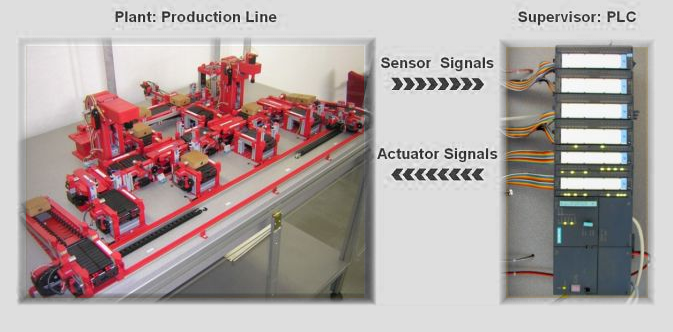
The laboratory model on the right represents a flexible manufacturing system. It consists of 29 interacting electro-mechanical components (conveyor belts, pusher, stack-feeder etc.), equipped with 25 actuators (DC-motors) and 57 sensors (key-switches, inductive sensors). The traditional engineering solution to operate the manufacturing system is to program a logic controller (PLC) such that it activates the appropriate motors in reaction on sensor events. This approach crucially relies on the programmer, who must consider any possible configuration of the system. While methods from software engineering assist the programmer and increase productivity, the process by principle remains error prone and unsafe.
Control Theory for Discrete Event Systems!
The manufacturing system can be formally modelled as a discrete-event system (DES). In contrast to continuous states and continuous time used in physically motivated models, discrete-event systems are characterized by discrete and qualitative changes of (symbolic) state values caused by the occurrence of asynchronous discrete events. In the context of our example, the control theoretic perspective on this system class is of a particular interest: given the formal model of the manufacturing system (plant dynamics) and the desired behaviour (formal specification), how can one systematically derive the required PLC program (controller dynamics) that makes ends meet?
Supervisory control theory (SCT) is a framework that provides an answer to the above question, first proposed by P.J. Ramadge and W.M. Wonham in the late 1980s. Since then, many researchers have contributed, including our group, with a particular focus on hierarchical, decentralized and/or modular control system architectures. At the time of writing, the required controller dynamics for systems of the complexity as our laboratory model can be synthesised easily by methods from supervisory control theory. Ongoing projects address the integration of synthesis algorithms with the work-flow of PLC programming, open questions related to fault detection and diagnosis, as well as network implementations of distributed supervision.
Contact
| thomas.moor@fau.de [pgp public key] | |
| Address |
Prof. Dr.-Ing. Thomas Moor Lehrstuhl für Regelungstechnik Friedrich-Alexander Universität Erlangen-Nürnberg Cauerstr. 7 91058 Erlangen Germany |
| Phone | +49 9131 8527129 |
| Fax | +49 9131 8528715 |